RTX PRO 4000 Blackwell vs RTX 3090 Ti for local LLMs: Qwen3.8-27B benchmarks
Is a single-slot RTX PRO 4000 Blackwell a viable second GPU instead of another 3090 Ti? llama.cpp benchmarks on Qwen3.8-27B, power cost in CHF, and both cards split together
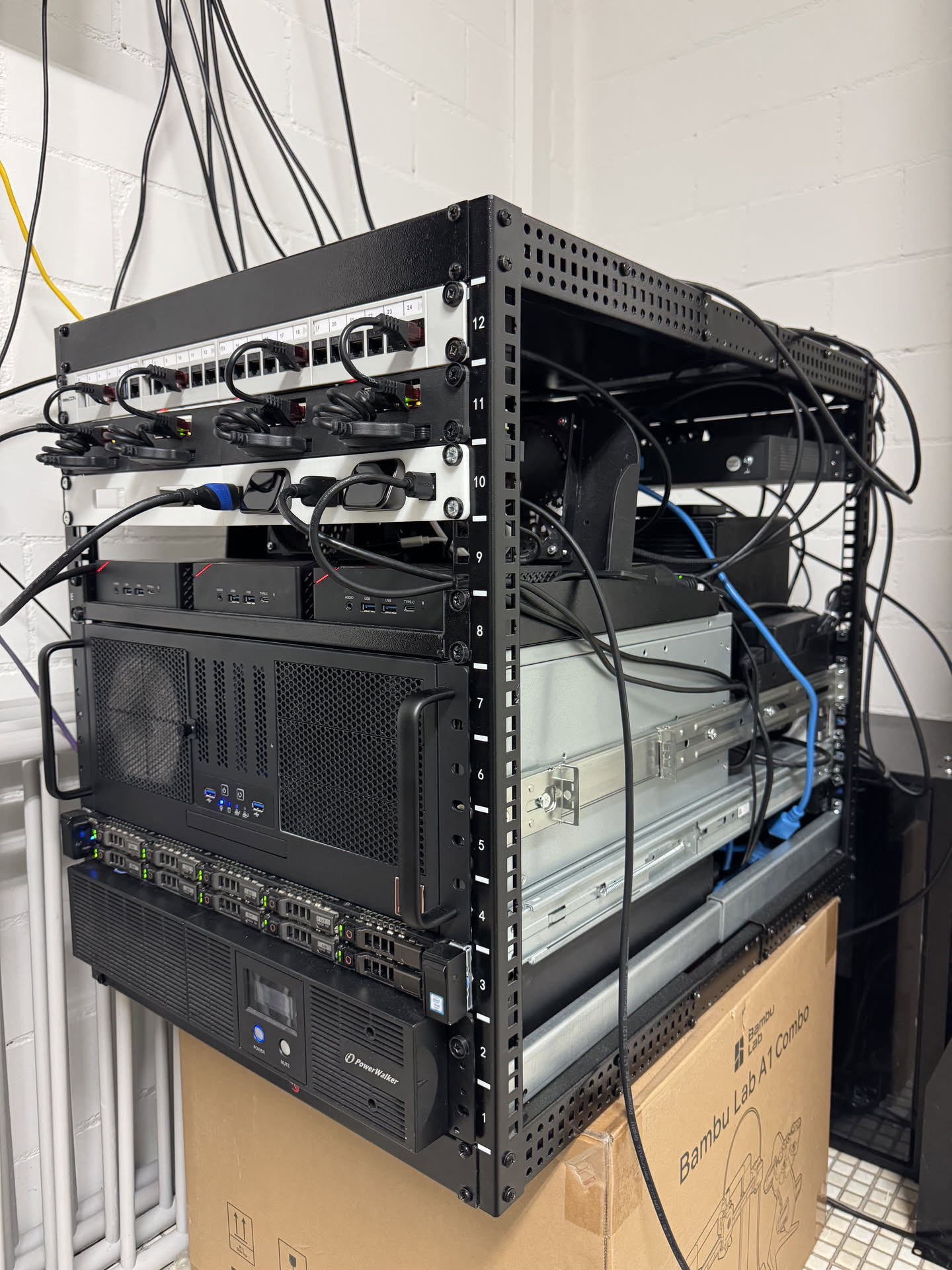
My AI node already has a used RTX 3090 Ti. I wanted a second 24GB card, but a second 3090 Ti is three slots and doesn’t fit in the case. The only option was a single-slot card, so I bought an RTX PRO 4000 Blackwell and benchmarked it against the 3090 Ti to check it was worth it.
Verdict
- Single card: the PRO 4000 does 88% of the 3090 Ti’s generation speed at my usual 300W cap, 98% of its prompt speed, and 104% of its batched throughput, at 145W.
- Against a stock 450W 3090 Ti it does 68% of the generation speed.
- Efficiency: 4.5 J per generated token vs 8.3 J (300W) and 9.5 J (450W). Idle is ~4W vs 22-31W.
- Paired: the two cards together run Q8_0 (29GB), which neither card can load alone, at 25 t/s, and split Q4 at 40.5 t/s, faster than either card alone.
- Cost: CHF 1,600 vs CHF 750 for the used 3090 Ti. Power savings don’t recover the difference. You pay for the single slot.
For a build that can only take a single-slot card, the PRO 4000 is the right call.
Setup
- Node: Ryzen 7 9700X, 64GB RAM, Talos Kubernetes
- Model: Qwen3.8-27B (dense), GGUF UD-Q4_K_M (16.5GB). Q4_0, UD-Q5_K_M and Q8_0 also tested.
- Runtime: llama.cpp B11096, CUDA 12.
llama-benchwith 128-token generation and 512/2048-token prompts;llama-batched-benchfor concurrency. - Not tested: FP8 and NVFP4 via vLLM. The weights exceed 24GB.
| RTX 3090 Ti | RTX PRO 4000 Blackwell | |
|---|---|---|
| Architecture | Ampere (GA102), 2022 | Blackwell (GB203), 2025 |
| Launch price (US) | $1,999 | $1,799 (reported) |
| Swiss price, 10 Oct 2026 | Not sold new; used CHF 1,000-1,850 on Ricardo | New from CHF 2,250 (OEM), CHF 2,556 (PNY retail) |
| What I paid | CHF 750, used | CHF 1,600 |
| Memory | 24GB GDDR6X, 384-bit | 24GB GDDR7 ECC, 192-bit |
| Memory bandwidth | 1,008 GB/s | 672 GB/s |
| CUDA cores | 10,752 | 8,960 |
| Tensor cores | 3rd gen | 5th gen (FP4 support) |
| FP32 | 40 TFLOPS | 40 TFLOPS |
| Power | 450W, 3x 8-pin or 16-pin | 145W, 1x 16-pin |
| Idle power (measured) | 22-31W | ~4W |
| Size | 3-slot | Single-slot blower |
| PCIe | Gen 4 x16 (x8 in my box) | Gen 5 x16 (x8 in my box) |
Used 3090 Ti prices: €1,100-1,800 in Germany; on eBay up from under $800 to about $1,500. CHF 750 was well below market.
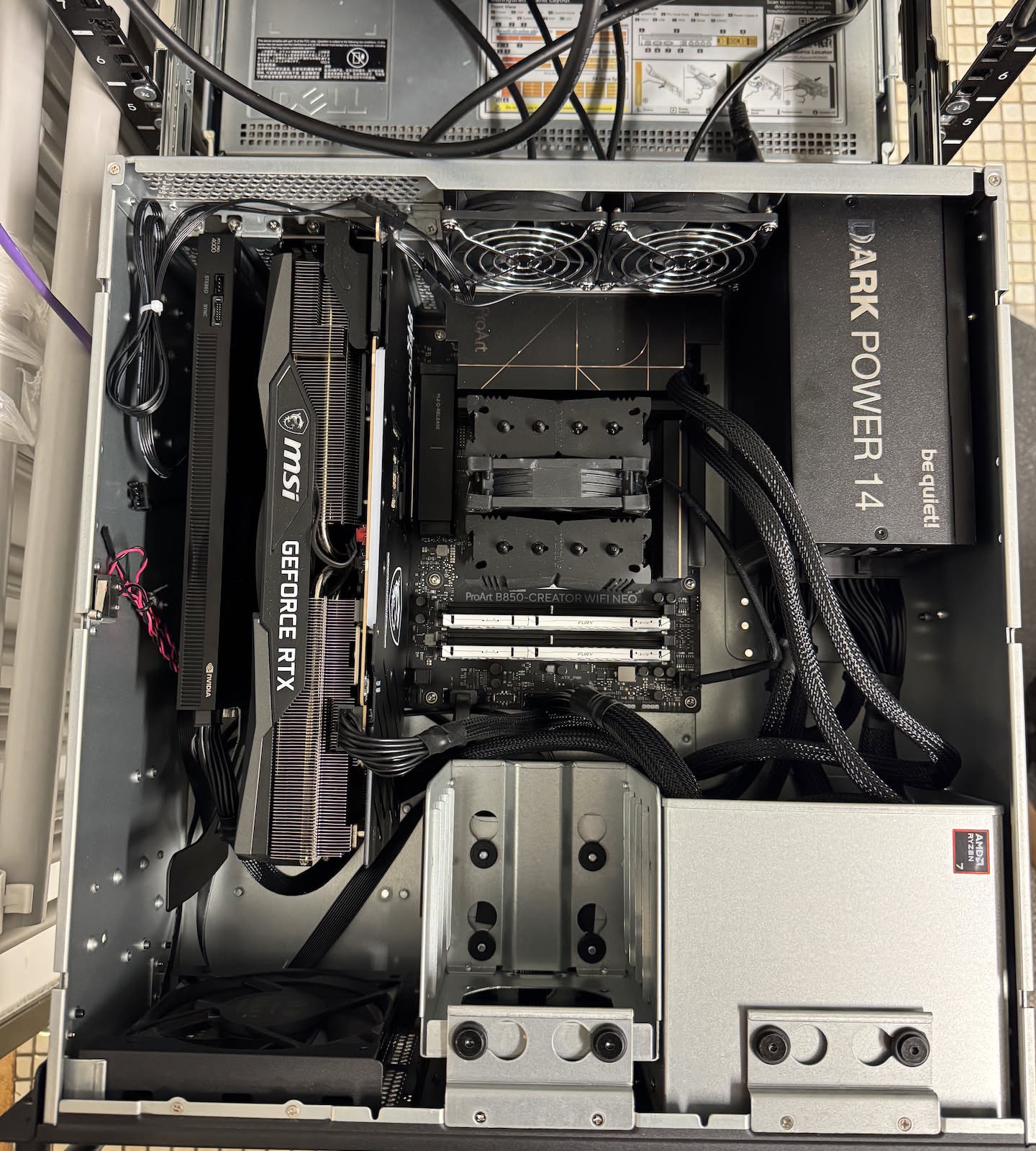
Single-slot PRO 4000 on the left, three-slot 3090 Ti on the right.
Single user
UD-Q4_K_M:
| Metric | 3090 Ti (450W) | 3090 Ti (300W) | 3090 Ti (145W) | PRO 4000 (145W) |
|---|---|---|---|---|
| Prompt (2048, 0 context) | 1591 t/s | 1258 t/s | 309 t/s | 1234 t/s |
| Gen (0 context) | 47.5 t/s | 36.5 t/s | 11.3 t/s | 32.1 t/s |
| Gen (32K context) | 40.1 t/s | 28.9 t/s | 9.2 t/s | 26.7 t/s |
- 3090 Ti at 450W vs PRO 4000: +48% generation (+53% with UD-Q5_K_M).
- 3090 Ti at 300W vs PRO 4000: +14% generation, +2% prompt.
- 3090 Ti capped at 145W: SM clocks drop to ~300 MHz (vs ~1900 MHz at 450W), it still draws ~168W, and the PRO 4000 is ~3x faster at generation. The full suite took 38 minutes vs 9 at 450W. Don’t run a 3090 Ti at 145W.
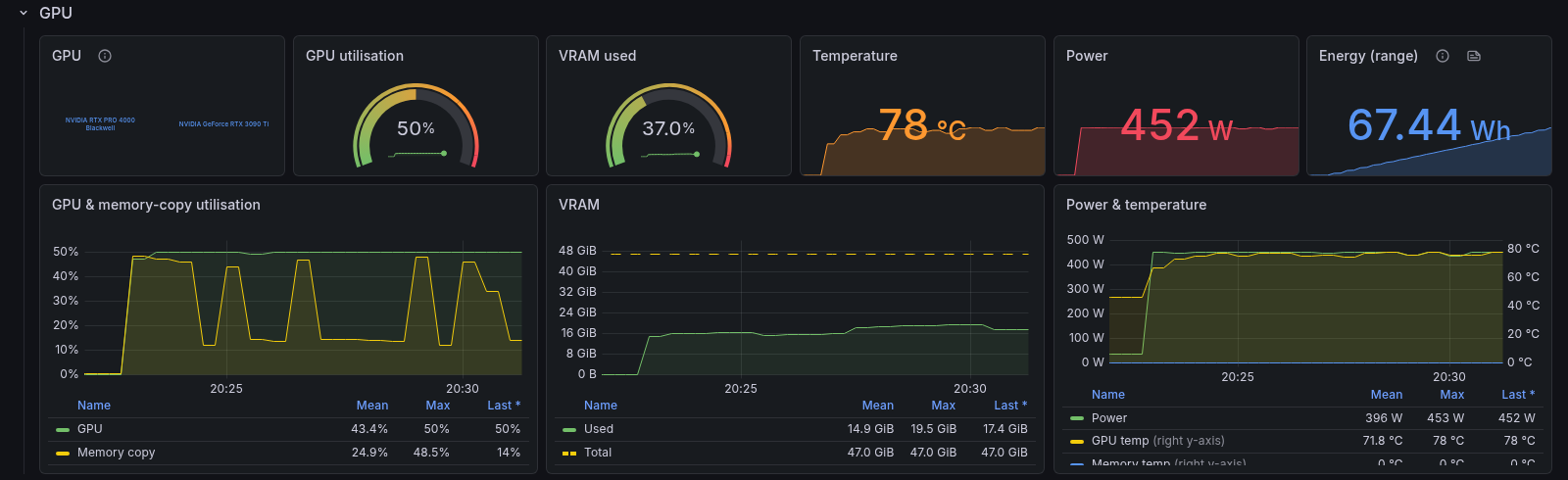
3090 Ti at 450W. Power is the sum of both cards, so it includes the idle PRO 4000 (~4W).
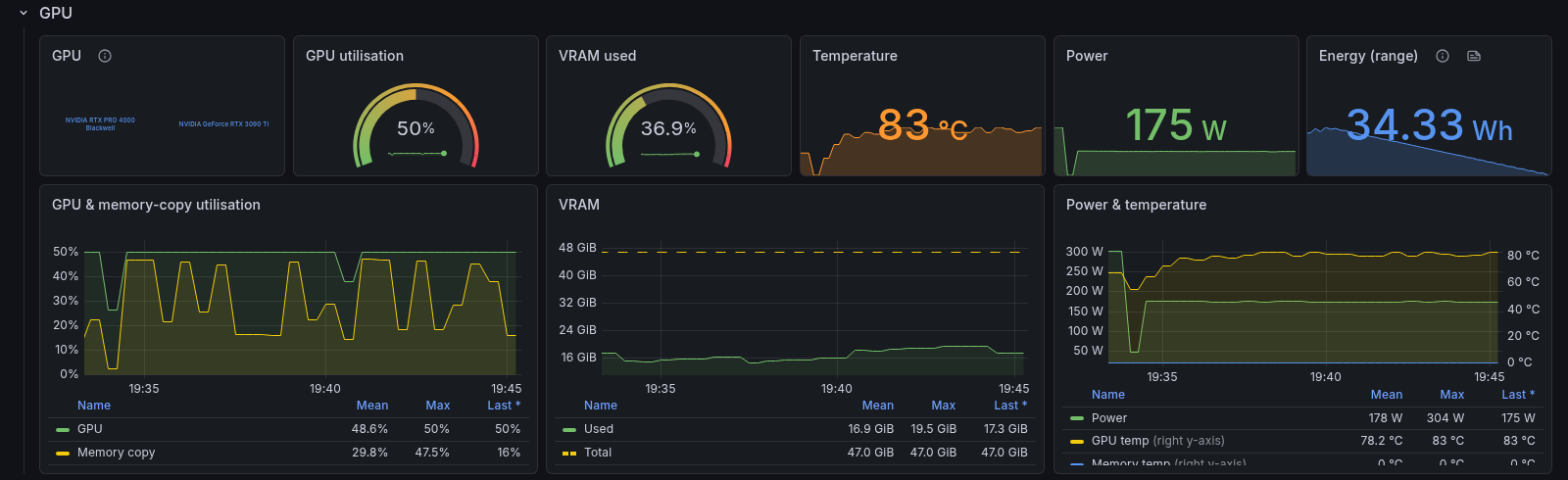
PRO 4000 pinned at 145W, up to 83°C. Includes the idle 3090 Ti (22-31W).
Batched throughput
llama-batched-bench, 16 parallel requests:
| Card | Total t/s |
|---|---|
| 3090 Ti (450W) | 249 |
| 3090 Ti (300W) | 205 |
| PRO 4000 (145W) | 214 |
Both cards show a step up in total throughput at a certain batch size: the PRO 4000 between 6 and 8 requests (93 -> 148 t/s), the 3090 Ti between 8 and 12.
Power cost
Electricity at 0.28 CHF/kWh.
| Metric | 3090 Ti (450W) | 3090 Ti (300W) | PRO 4000 (145W) |
|---|---|---|---|
| Energy per generated token | 9.5 J | 8.3 J | 4.5 J |
| CHF per million generated tokens | 0.74 | 0.65 | 0.35 |
| Idle power | 22-31W | 22-31W | ~4W |
| Idle cost per year (24/7) | 55-77 CHF | 55-77 CHF | ~10 CHF |
| Purchase CHF per t/s | 15.80 | 20.90 | 50.00 |
Recovering the ~850 CHF price difference from power:
- Generating 24/7: ~2.2 billion tokens, ~2.2 years.
- Mostly idle: 45-67 CHF/year saved, 13-19 years.
Against OpenRouter
Qwen3.8 27B on OpenRouter, 19 providers (mostly FP8/FP4), 9 October 2026, at 0.83 CHF/USD. Prices per million tokens:
| Input | Output | |
|---|---|---|
| OpenRouter, cheapest | 0.02 CHF | 1.12 CHF |
| OpenRouter, median | 0.19 CHF | 1.91 CHF |
| OpenRouter, most expensive | 0.82 CHF | 3.91 CHF |
| PRO 4000, electricity only | under 0.01 CHF | 0.35 CHF |
| 3090 Ti (300W), electricity only | under 0.02 CHF | 0.65 CHF |
Local input costs are upper bounds: they assume the card sat at its power limit during prompt processing (not measured).
Payback against OpenRouter, single user, counting idle power for the rest of the day. “Busy” is the share of the day spent generating.
| Payback (vs median / vs cheapest) | Busy 10% | Busy 33% | Busy 100% |
|---|---|---|---|
| 3090 Ti, 300W (750 CHF) | 10 years / never | 1.8 / 5.9 years | 0.5 / 1.4 years |
| PRO 4000 (1,600 CHF) | 11 / 23 years | 3.1 / 6.4 years | 1.0 / 2.1 years |
Both cards together
llama.cpp layer split, 3090 Ti at 300W, both cards on PCIe x8 through the CPU, no NVLink.
| Metric | Both, 50/50 | Both, 60/40 | 3090 Ti (300W) | PRO 4000 |
|---|---|---|---|---|
| Prompt (2048, UD-Q4_K_M) | 1947 t/s | 1804 t/s | 1258 t/s | 1234 t/s |
| Gen (UD-Q4_K_M) | 39.3 t/s | 40.5 t/s | 36.5 t/s | 32.1 t/s |
| Prompt (2048, Q8_0) | 1816 t/s | 1772 t/s | - | - |
| Gen (Q8_0) | 24.6 t/s | 25.0 t/s | - | - |
- Split generation beats either card alone; split prompt processing is ~55% faster than either card alone and faster than the 3090 Ti at 450W.
- Q8_0 (29GB) only fits across both cards.
- 16-request batch: 242 t/s total.
- Row split failed to load the model. Tensor split crashed with a CUDA error.
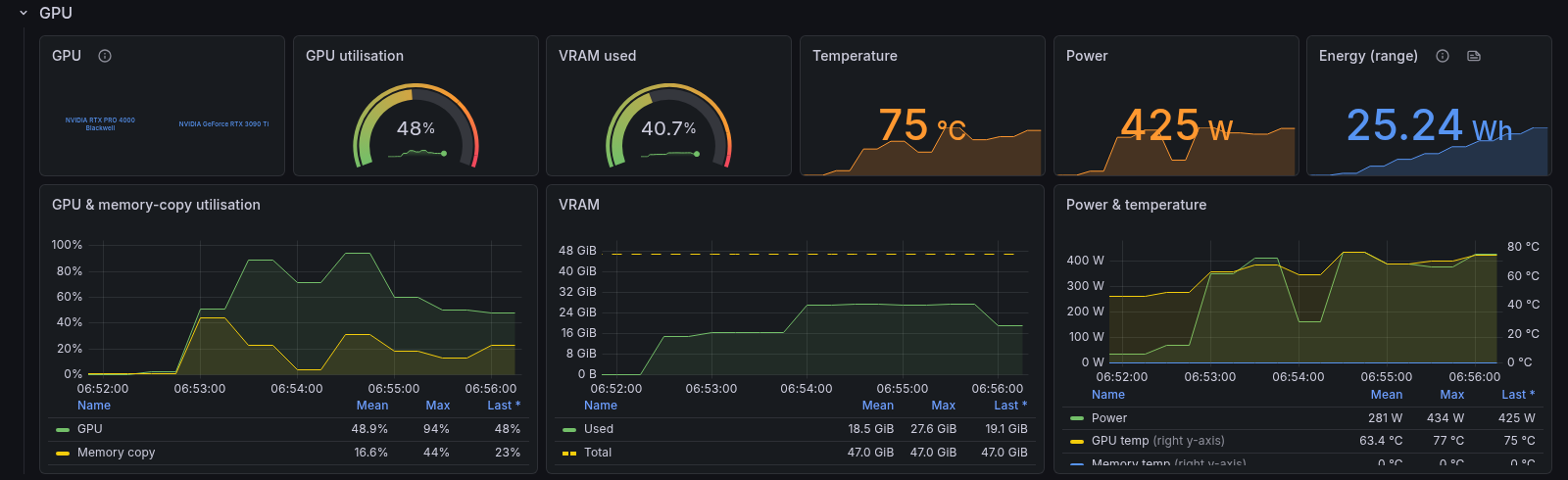
Both cards, peaking at 434W. The 27.6GB VRAM peak is the Q8_0 run.
How the cards are used now
- PRO 4000: always-on inference for my agents, since it idles at ~4W.
- 3090 Ti: ComfyUI, game streaming, and testing new models.